|
| |||||||||||||||
|
| |||||||||||||||

| |||||||||||||||||||||
A carpet is any loom-woven, felted textile or grass floor covering.
The term was also used for table and wall coverings, as carpets were not
commonly used on the floor in European interiors until the 18th century. The
hand-knotted pile carpet probably originated in
Central
Asia between the 3rd and 2nd millennium BC. Carpet-making was introduced to
Spain in 10th century by the Moors. The Crusades brought
Turkish carpets to all of Europe, where they were primarily hung on walls or
used on tables. Only with the opening of trade routes in the 17th century were
significant numbers of
Persian
rugs introduced to Western Europe.
Some use the words carpet and rug interchangeably. Historically,
however, some have distinguished between carpet and rug based on size (the
former being larger) or use (carpets on floors, rugs on beds or on the hearth).
For the sake of clarity, some textile scholars also differentiate between
carpets and carpeting. In this usage, the latter are wall-to-wall and are
often woven or tufted as "roll goods", most often in 12 foot widths but
sometimes in up to 15 foot widths. In the real estate and home improvement
industries a distinction is made between carpet (or carpeting) and rug. The
former indicates a covering that is affixed to a floor and the latter a floor
covering that is loose-laid, most often for decorative purposes.


The global carpet market for domestic and industrial end use is dominated by
three manufacturing processes:
Woven: The carpet is produced on a loom similar to woven cloth and is
a cut pile. Normally many coloured yarns are used and this process is capable of
producing intricate patterns from pre-determined designs. These carpets are
normally the most expensive.
Tufted: The carpet is produced on a tufting machine using a
single-colored or sometimes non-colored yarn. If non-colored yarn is used the
carpet will later be dyed or printed with a design. Tufted carpets can be either
cut pile, loop pile or a combination of both. Tufting machines produce many more
metres of carpet per hour than weaving does, and tufted carpets are usually low-
to medium-priced.
Modern tufting technology allows basic geometric patterns to be produced in
addition to solid color. The fibers used to create the patterns are twisted into
yarns and then "tufted" into carpet. Because tufting machines work like enormous
sewing machines with multiple needles, tufted carpet can be produced quickly.
For this reason, most of the carpet manufactured today is tufted rather than
woven.
A ColorTEC carpet is manufactured on a tufting machine but is capable
of producing a design that is close to that of a woven carpet. ColorTec
carpet can have a design up to 20 yards (18m) in length and allows the whole
floorscape to be produced rather than small patterns being repeated.
Needlefelt: These carpets are more technologically advanced.
Needlefelts are produced by electrostatic attraction of individual synthetic
fibers forming an extremely durable carpet. These carpets are normally found in
the contract market such as hotels etc. where there is a lot of traffic.
A flatweave carpet is created by interlocking
warp (vertical) and
weft (horizontal) threads. Types of oriental flatwoven carpet include
kilim,
soumak,
plain
weave, and
tapestry weave. Types of European flatwoven carpets include Venetian, Dutch,
damask, list,
haircloth,
and
ingrain (aka double cloth, two-ply, triple cloth, or three-ply).
A hooked rug is a simple type of rug handmade by pulling strips of
cloth such as wool or cotton through the meshes of a sturdy fabric such as
burlap. This type of rug is now generally made as a
handicraft.
On a knotted pile carpet (formally, a supplementary weft cut-loop
pile carpet), the structural weft threads alternate with a supplementary
weft that rises at right angles to the surface of the weave. This supplementary
weft is attached to the warp by one of three knot types (see below) to form the
pile or nap of the carpet.
In the late 19th century moquette came to mean
wall-to-wall carpeting. However, historically it meant a supplementary
warp-cut or uncut loop pile made on a
draw loom (aka Velour d'Utrecht, Brussels, Wilton,
bouclé, and Frisé). These textiles have a low pile and are thinner
than hand knotted pile carpets. This form of carpeting, made as early as the
16th century, is constructed on a mechanized loom like
velvet: the
supplementary warps loop under the weft and are attached without forming a knot.
Because of the loom structure only five colors can be used to create the design.
Moquette is woven in relatively narrow panels (usually 27" or 36"). Larger works
are composed of several stripes sewn together. Moquette carpets have been used
on floors and tables, and as furniture upholstery and wall coverings. Production
was improved with the application of the Jacquard mechanism (see
Jacquard loom) in 1812 in France and c. 1825 in England, and by the
introduction of steam power in the mid-19th century.

Unlike woven carpets,
embroidery
carpets are not formed on a loom. Their pattern is established by the
application of
stitches to a
cloth (often
linen) base. The tent stitch and the cross stitch are two of the most
common. Embroidered carpets were traditionally made by royal and aristocratic
women in the home, but there has been some commercial manufacture since steel
needles were introduced (earlier needles were made of bone) and linen weaving
improved in the 16th century.
Mary
Stewart Queen of Scots is known to have been an avid embroiderer. 16th
century designs usually involve scrolling vines and regional flowers (for
example, the
Bradford carpet). They often incorporate animal heraldry and the
coat of
arms of the maker. Production continued through the 19th century.
Victorian embroidered carpet compositions include highly illusionistic,
3-dimensional flowers. Patterns for tiled carpets made of a number of squares,
called
Berlin wool work, were introduced in Germany in 1804, and became extremely
popular in England in the 1830s.
Both flat and pile carpets are woven on a
loom. Both vertical
and horizontal looms have been used in the production of European and Oriental
carpets.
The warp threads
are set up on the frame of the loom before weaving begins. A number of weavers
may work together on the same carpet. A row of knots is completed and cut. The
knots are secured with (usually 1 to 4) rows of
weft.
There are several styles of knotting, but the two main types of knot are the
symmetrical (also called Turkish or Ghiordes) and asymmetrical
(also called Persian or Senna).

Contemporary centers of oriental carpet production are:
Iran,
Pakistan,
India,
Turkey,
Northern Africa, the
Caucasus,
Nepal,
Spain,
Turkmenistan, and
Tibet.
The importance of carpets in the culture of Turkmenistan is such that
the national flag features a vertical red stripe near the hoist side,
containing five carpet guls (designs used in producing rugs).
Child labour has often been used in Asia. The
Rugmark
labelling scheme used throughout
Europe and
North
America assures that child labour has not been used: importers pay for the
labels, and the revenue collected is used to monitor centres of production and
educate previously exploited children.
| Garden Angelica | ||||||||||||||
|---|---|---|---|---|---|---|---|---|---|---|---|---|---|---|
 | ||||||||||||||
| Scientific classification | ||||||||||||||
| ||||||||||||||
| Binomial name | ||||||||||||||
| Angelica archangelica L. |
Garden Angelica (Angelica archangelica; syn. Archangelica officinalis Hoffm.,
Archangelica officinalis var. himalaica C.B.Clarke) is a biennial plant from the umbelliferous
family Apiaceae. Alternative English
names are Holy Ghost, Wild Celery, and Norwegian angelica
During its first year it only grows leaves, but during its second year its
fluted stem can reach a height of two metres. Its leaves are composed of
numerous small leaflets, divided into three principal groups, each of which is
again subdivided into three lesser groups. The edges of the leaflets are finely
toothed or serrated. The flowers, which blossom in July, are small and numerous,
yellowish or greenish in colour, are grouped into large, globular umbels, which
bear pale yellow, oblong fruits. Angelica only grows in damp soil, preferably
near rivers or deposits of water. Not to be confused with the toxic Pastinaca
sativa, or Wild Parsnip.
Angelica archangelica grows wild in Finland, Sweden, Norway,
Greenland, the Faroe Islands and Iceland, mostly in the northern parts of
the countries. It is cultivated in France, mainly in the Marais Poitevin, a marsh region close to Niort in the départment Deux-Sèvres.
From the 10th century
on, angelica was cultivated as a vegetable and medicinal plant, and achieved great popularity
in Scandinavia in the 12th century and is still
used today, especially in Sami
culture. A flute-like instrument with a clarinet-like sound can be made of
its hollow stem, probably as a toy for children. Linnaeus reported that Sami peoples used it in
reindeer milk. Other usages include
spices.
In 1602, angelica was introduced in Niort, which had just been ravaged by the plague, and it
has been popular there ever since. It is used to flavour liqueurs or aquavits (e.g. Chartreuse, Bénédictine, Vermouth and Dubonnet), omelettes and trout, and as jam. The
long bright green stems are also candied and used as decoration.
Angelica contains a variety of chemicals which have been shown to have
medicinal properties. Chewing on angelica or drinking tea brewed from it will
cause local
anesthesia, but it will heighten the consumer's immune system. It has been shown to be effective
against various bacteria, fungal infections and even viral infections.[citation needed]
The essential oil of
the roots of 'Angelica archangelica contains β-terebangelene,
C10H16, and other terpenes; the oil of the seeds also contains
β-terebangelene, together with methylethylacetic acid and hydroxymyristic
acid.
Angelica seeds and angelica roots are sometimes used in making absinthe.
| Pashupatinath Temple | |||
 | |||
| Name: | Pashupatinath Temple | ||
|---|---|---|---|
| Date built: | At least 1500 years back | ||
| Primary deity: | Pashupatinath | ||
| Architecture: | pagoda | ||
| Location: | Kathmandu, Nepal | ||
Pashupatinath temple (पशुपतिनाथ मन्दिर) is a Hindu temple located on the shore of the Bagmati river on the eastern part of Kathmandu, the capital of Nepal.
It is regarded as the most sacred temple of Shiva (Pashupati) in the world. Thousands of pilgrims from
all over the world, particularly from Nepal and India pay
homage to this temple everyday. "Shivaratri" or night of lord Shiva is an especially
important day in this temple when tens of thousands of people throng here for
the annual celebration.
Locals have long regarded Pashupatinath temple as a very important part of
the city, both religiously and culturally. Thousands of locals begin their day
by visiting the temple and receiving blessings from lord Shiva early in the
morning. Along the shores of the Bagmati river near the temple lies "Arya Ghat",
the most widely used place of cremation for the deceased in Nepal, especially in
and around the Kathmandu valley. There is also a large market in the streets
surrounding the temple. Vendors sell souvenirs to tourists, but also cloth,
dyes, and religious supplies.
Believers of the faith Hinduism
are allowed to enter the temple. Non-Hindu visitors are allowed to have a look
at the temple from the other bank of Bagmati river
The unique feature of this temple is that only four priests can touch the
idol. The priests are always from south India. This tradition is supposed to
have started by Sage Shankaracharya in 6th century, ostensibly to stop human sacrifice which
was prevalent in that temple.
The more official view of Indian priests being stationed at Pashupatinath is
because when the King passes away, the entire Nepali people are supposed to stop
religious services and enter a year long period of mourning. As the
Pashupatinath needs to be eternally worshipped, Indians were brought to make
sure that the Pashupatinath is worshipped even at the time of official
mourning.
The temple is of pagoda architecture.
The two level roofs are of copper with gold covering. It has four main doors,
all covered with silver sheets. The western door has a statue of large bull or
Nandi, again covered in gold. The idol is of black stone, about 6 ft in height
and about 6ft circumference.
The priests are called Bhattas and
the chief priest is known as Mool Bhatt or Raval. The chief priest
is answerable only to the King of Nepal and reports to him on the matters
of temple on periodic basis.
East of the temple is the Vasukinath.
One of the most known Chief Priest was Raval Padmanabha Shastri Adiga
(1927-2005). He started as a priest in 1955 and was promoted as Chief priest in
1967. In his time, he started a movement to use the temple funds for local
development. He retired in 1993 and moved back to his home town Udupi. Nepal is said to be run by Pashupatinath.Everytime
in history when Nepal has bad rulers bad government the country is still run and
still exists.Recent times with all corrupt leaders and mad king , strikes,
bandas, nepal is still governed by Pashupatinath.jay sumbho.
 Pashupatinath Temple |  Pilgrim in Pashupatinath |  Dye seller outside Pashupatinath |  Shiva temple in Pashupatinath |
 A holyman crosses Bagmati river with a plank of wood |
The Yeti or Abominable Snowman is an apelike cryptid said to inhabit the Himalaya region of Nepal and Tibet.
The names Yeti and Meh-Teh are commonly used by the people
indigenous to the region,[1] and are part of their history and mythology. Nepalese have various
names for Yeti like "Bonmanche" which means "wild man" or "Kanchanjunga rachyyas" which means "Kanchanjunga's
demon."
Most mainstream scientists,
explorers and writers consider current evidence of the Yeti's existence to be
weak and better explained as hoax, legend or misidentification of known
species.[2] Even today, the Yeti remains one of the most
famous creatures of cryptozoology. As such, the Yeti can be
considered a Himalayan version of the Sasquatch.
 | |
| Purported Yeti scalp at Khumjung monastery | |
| Creature | |
| Name: | Yeti |
| AKA: | Abominable Snowman Migoi, Meh-teh et al. |
| Classification | |
| Grouping: | Cryptid |
| Sub grouping: | Hominid |
| Data | |
| Country: | Nepal, Tibet |
| Region: | Himalayas |
| Habitat: | Mountains |
Events and Studies
In 1832, the
Journal of the Asiatic society of Bengal published trekker
B. H. Hodgson's account of the Yeti in northern
Nepal. His native
guides spotted a tall, bipedal creature covered with long dark hair, which
seemed to flee in fear. Hodgson did not see the creature, but concluded it was
an orangutan.
An early record of reported
footprints
appeared in 1889 in
L.A.
Waddell's
Among the Himalayas. Waddell reported his guide's description of a large
apelike creature that left the prints, which Waddell concluded were actually
made by a bear.
Waddell heard stories of bipedal, apelike creatures, but wrote that of the many
witnesses he questioned, none "could ever give ... an authentic case. On the
most superficial investigation it always resolved into something that somebody
had heard of."
The frequency of reports increased during the early
20th
century, when Westerners began making determined attempts to scale the many
mountains
in the area and occasionally reported seeing odd creatures or strange tracks.
In 1925,
N.A.
Tombazi, a
photographer and member of the
Royal Geographical Society, allegedly saw a creature at about 15,000 ft
(4572 meter) near Zemu
Glacier.
Tombazi later wrote that he observed the creature from about 200 or 300
yards, for about a
minute. "Unquestionably, the figure in outline was exactly like a human being,
walking upright and stopping occasionally to pull at some
dwarf
rhododendron
bushes. It showed up dark against the snow, and as far as I could make out,
wore no clothes." About two hours later, Tombazi and his companions descended
the mountain, and saw what they assumed to be the creature's prints, described
as "similar in shape to those of a man, but only six to seven inches long by
four inches wide... The prints were undoubtedly those of a biped."

Dr. Biswamoy Biswas examining the Pangboche Yeti scalp during the
Daily
Mail Snowman Expedition of
1954
The
Daily Mail "Snowman Expedition" of
1954, on
March 19
printed an article which described expedition teams obtaining hair specimens
from a scalp found in Pangboche monastery. The hair was analysed by Professor
Frederic Wood Jones, F.R.S, D.Sc., (who died on
September 29 1954[25][26])
and an expert in human and comparative anatomy.
The research consisted of taking microphotographs of the hairs and comparing
them with hairs from known animals such as bears and orangutans. Professor
Woods-Jones concluded that the hairs of the Pangboche scalp were not actually
from a scalp. He contended that some animals do have a ridge of hair extending
from the pate to the back, but no animals have a ridge (as in the Pangboche
relic) running from the base of the forehead across the pate and ending at the
nape of the neck.
The hairs were black to dark brown in colour in dim light, and fox red in
sunlight. None of the hairs had been dyed and were probably exceedingly old.
During the study, the hairs were bleached, cut into sections and analysed
microscopically. Wood-Jones was unable to pinpoint the animal from which the
Pangboche hairs were taken. He was, however, convinced that the hairs were not
of a bear or anthropoid ape. He suggested that the hairs were not from the head
of a coarse-haired hoofed animal, but from its shoulder.
Western interest in the Yeti peaked dramatically in the 1950s. While
attempting to scale Mount Everest in 1951,
Eric
Shipton took
photographs
of a number of large prints in the snow, at about 6,000 m (19,685 ft) above
sea level.
These photos have been subject to intense scrutiny and debate. Some argue they
are the best evidence of Yeti's existence, while others contend the prints to be
from a mundane creature, and have been distorted by the melting
snow.
In 1953,
Sir
Edmund Hillary and
Tenzing Norgay reported seeing large footprints while scaling
Mount
Everest. But Hillary would later discount Yeti reports as unreliable.[28]
During the
Daily Mail
Snowman Expedition of 1954,[29]
the largest search of its kind, the mountaineering leader
John Angelo Jackson, made the first trek from
Everest to
Kangchenjunga during which he photographed symbolic paintings of the Yeti at
Thyangboche Gompa.[30]
Jackson tracked and photographed many footprints in the snow, most of which were
identifiable. However, there were many large footprints which could not be
identified. The flattened footprint-like indentations were attributed to erosion
and subsequent widening of the original footprint by wind and particles.
Beginning in 1957, wealthy
American
oilman
Tom Slick funded a few missions to investigate Yeti reports. In 1959,
supposed Yeti feces
were collected by Slick's expedition; fecal analysis found a
parasite
which could not be classified.
Bernard Heuvelmans wrote, "Since each animal has its own parasites, this
indicated that the host animal is equally an unknown animal."
In 1959, actor
Jimmy Stewart, while visiting
India, reportedly
smuggled remains of a supposed Yeti, the so-called
Pangboche Hand, by concealing it in his luggage when he flew from India to
London
In 1960, Sir Edmund Hillary mounted an expedition to collect and analyse
physical evidence of the Yeti. He sent a Yeti "scalp"
from the
Khumjung
monastery to the West for testing, whose results indicated the scalp to be
manufactured from the skin of the
serow,
a goat-like Himalayan antelope. But some disagreed with this analysis.
Myra
Shackley said that the "hairs from the scalp look distinctly monkey-like,
and that it contains parasitic mites of a species different from that recovered
from the serow."[citation
needed]
In 1970, British mountaineer
Don
Whillans claims to have witnessed a creature when scaling
Annapurna.
While scouting for a campsite, Whillans heard some odd cries which his Sherpa
guide attributed to a Yeti's call. That very night, Whillans saw a dark shape
moving near his camp. The next day, he observed a few human-like footprints in
the snow, and that evening, viewed with
binoculars
a bipedal, apelike creature for 20 minutes as it apparently searched for food
not far from his camp.
[citation
needed] Nothing was seen again.
 http://en.wikipedia.org/wiki/Image:KaliNepal1920.jpg" width="200" height="269">
Nepalese art andcraft reflect the religiousthemes of Hinduism, Buddhism, and certain location specific depictions. The cultural history of Nepalese art are traditionally divided into five major periods:
Pre-Licchavi, Licchavi, transitional, early Malla (Newar), and late Malla (Newar) periods.
Most of the existing craftsmen areNewars.>
Folklores and folktales have remained an integral part of Nepalese society, and they reveal different dimensions of social and cultural life of the people. Sometales tell of love and affection, others recounthatred andbattles, including some which describedemons,ghosts andcannibalism. Nepalese folklores and folktales have various regional and ethnic colors, and some of them are variations of such tales of other areas which have traveled to Nepal, and being retold with changednames andplaces. There are other tales which are purely of Nepalese origin. Thus, tales in the area ofBhaktapur, complete with princes and richmerchants, can be traced to historical events and sometimes may also be dated.
Like folklores and folktales across theworld, such tales from Nepal are also rooted in the ground reality of day-to-day life, these folklores and folktales reflect local lifestyles, activities, beliefs,emotions,feelings,customs,superstitions, andinhibitions. They also celebrate the basic goodness of human nature, and sometimes reveal a deep faith in the supernatural.
As per 2001 census, at least 92 different living languages are spoken in Nepal, though other studies list 123 living languageshttp://www.ethnologue.com/show_country.asp?name=NP" href="http://www.ethnologue.com/show_country.asp?name=NP" rel="nofollow">[1]. Nepal’s linguistic heritage has evolved from three major language groups, namely,Indo-Aryan,Tibeto-Burman, andindigenous. The major languages of Nepal (percent spoken as mother tongue) areNepali (49%),Maithili (12%), Bhojpuri (8%), Tharu (6%),Tamang (5%),http://en.wikipedia.org/wiki/Nepal_Bhasa_(language)">Nepal Bhasa (4%), Magar (3%), Awadhi (2%),Bantawa (2%), Limbu (1%), andBajjika (1%). The remaining languages are each spoken as mother tongue by less than one percent of the population.Nepali, written inDevanagari script, is the official, national language and serves as lingua franca among Nepalese of different ethno linguistic groups. In the southernTerai Region (5 to 10 mile wide stretch of flat plains in the south which is a northern continuation of Gangetic plains of India),Hindi is also spoken.
Extinct languages of Nepal include Dura, Kusunda and Waling.
Among Nepalese writers isParijat.

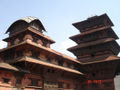
A Buddhist Monastery
The 2001census identified 80.6% of the population asHindu andBuddhism was practiced by about 11% of the population (although many people labelled Hindu or Buddhist often practice a syncretic blend of Hinduism, Buddhism and/or animist traditions). About 4.2% of the population isMuslim and 3.6% of the population follows the indigenousKirant religion.Christianity is practiced officially by less than 0.5% of the population.
Main article:Religion in Nepal
Hindu and Buddhist traditions in Nepal go back to more than two millennia. InLumbini, Buddha was born, andPashupatinath temple, Kathamandu, is an old and famousShiva temple. Nepal has several othertemples and Buddhist monasteries, and also places of worship of other religious groups.Tantric traditions are also deep rooted in Nepal, including the practice of animal sacrifices. Five type of animals, always male, are acceptable for sacrifice:buffaloes, goats,sheep,chickens, andducks.>
With%20a%20multiplicitygroup]]s,%20Nepal%20has%20several%20cults,%20and



 a href="http://www.rankingblogs.com/dir/index.php?a=in&u=rajib">


